
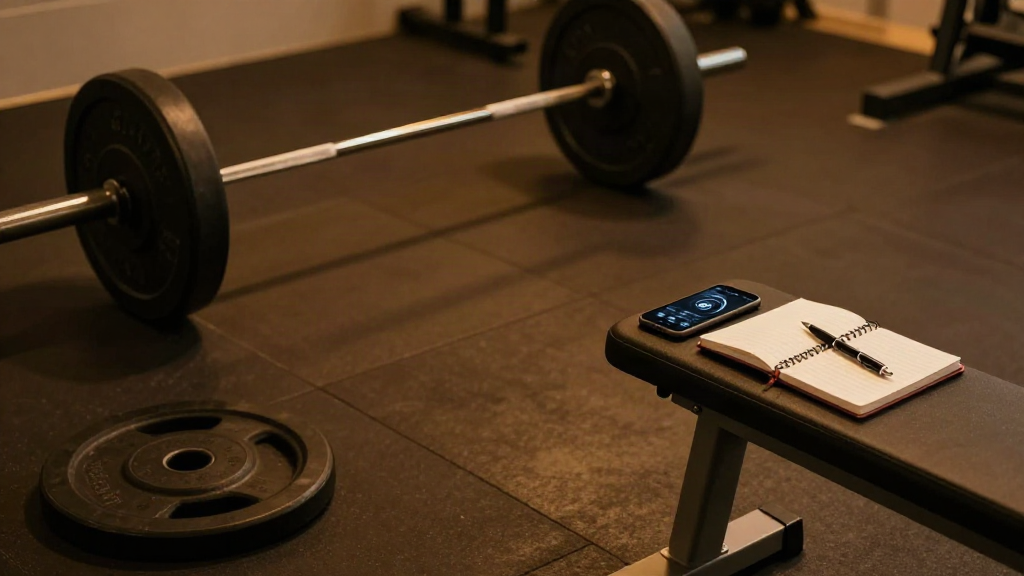
AI Workout Coach vs Manual Tracking: The Real Difference
Manual tracking has gotten lifters further than any app ever will. A notebook doesn't crash, doesn't ask for a subscription, and doesn't guess. So if it works, why switch?
Because the notebook records what you did. It doesn't reason about it. That gap is the whole argument between an AI workout coach and manual tracking, and it decides more progression calls than you probably think.
This isn't a pitch against paper. It's a straight comparison of where each approach wins, where manual tracking quietly breaks down, and which one actually builds more strength over a training block.
What manual tracking does well
Give the notebook credit. It's fast once it's a habit, it costs nothing, and it's yours. No sync, no login, no company deciding to change its pricing or retire a feature. If you train the same lifts week after week and your program is simple, a notebook plus a pen is genuinely hard to beat.
Manual tracking also forces you to pay attention. Writing down a set makes you notice the weight, the reps, the RPE. For a beginner or someone returning after time off, that attention is the main benefit. The log is almost a side effect.
The problems start when the program stops being simple.
Where manual tracking breaks down
It breaks down on volume, on history, and on speed under load.
Volume first. A basic linear program has one variable to manage: add weight. Real intermediate and advanced programs don't. They rotate intensity, juggle rep ranges, run waves, and track weekly tonnage per muscle group. Keeping that straight in your head, or in a notebook, means doing arithmetic between sets. Most people don't. They eyeball it, and eyeballing drifts.
History next. A paper log holds a record but not a query. Ask it "what did my bench look like eight weeks ago at this rep range, and did I actually beat it last week?" and you're flipping pages. That's the exact question progressive overload depends on, and it's the one the notebook makes hardest to answer.
Then speed. Under a heavy set, the notebook asks you to stop, find the page, write in a cramped hand, and remember what you wrote two sets ago. Every second of that is time you're not recovering or training. And the data you enter at rep 8 of a hard set is the data most likely to be wrong.
How an AI coach that reads your actual sets changes the decision
Here's the real shift: an AI workout coach doesn't just store your sets. It reads them.
That means the progression call stops being a guess. When you ask, the coach reads your recent sessions set by set (the weights, the reps, the order you did them in) plus how each lift has trended over the last six weeks, and it reasons over that history the way a good training partner would. It sees every working set, so you can ask whether your back-off sets are keeping up with your top set. It sees weekly volume for each muscle and how last week compares with the week before. It knows your current bodyweight and how it moved over the past month, and it can flag a muscle you have not trained for a while.
Manual tracking can hold all of that. It can't connect it.
The difference shows up in three places:
- Progression, not just recording. Instead of you deciding whether to add 5 pounds or repeat the weight, the coach makes the call from your actual numbers and tells you why. In Lyfto that is part of Pro on iPhone, and included on Android.
- No re-logging last week's numbers. Your history is already there, structured, searchable in a second. You load the session, not the spreadsheet.
- Consistency you don't have to police. Missed sessions, stalled lifts, and odd volume show up as patterns, not as scattered scribbles you have to reconstruct yourself.
None of that replaces your judgment. It upgrades the inputs your judgment runs on.
Speed, data ownership, Apple Watch, and training with a crew
The practical gaps are where most lifters actually feel the difference.
Speed. A good workout tracker lets you log a set in seconds, including from your wrist with an Apple Watch paired to your iPhone. That's the opposite of the notebook stop-and-write. Over a four-set lift across six exercises, the seconds add up to real training time.
Data ownership. This is a fair worry, and manual tracking wins the purity argument by default: paper can't be sold, mined, or locked behind a login. The honest answer is to check how any tool handles your data before you commit. Data ownership isn't something a notebook automatically earns by being analog. It's something a tool either respects or doesn't.
Apple Watch. If you train with a watch on, the wrist is the fastest interface you own. A coach built for iPhone and Apple Watch turns logging into a turn of the crown and a tap instead of a detour to a bench and a pen.
Training with a crew. Manual tracking is single-player. Your notebook doesn't know your training partner's numbers, and it never will. In Lyfto your crew shares a group feed, PRs and a weekly volume battle, but the coach itself reads only your own history.
Which one actually builds more strength
Here's the blunt version. If your program is simple and your progression is obvious, manual tracking is enough, and an AI coach is a nicety.
If your program is complex (multiple rep ranges, rotating intensity, weekly volume you're supposed to track per muscle group), then the bottleneck isn't effort. It's the reasoning. Manual tracking gives you the raw data and asks you to do the analysis by hand, set after set, week after week. That's where lifters stall: not from undertraining, but from failing to notice that a lift stopped progressing three weeks ago.
An AI workout coach closes that loop. It reads your recent sets, connects last week to this week, and helps you make the call you'd make if you had the time and the memory to make it perfectly. The strength gains don't come from the app. They come from progressive overload actually happening: consistently, on purpose, without you doing arithmetic at rep 8.
The short version
Manual tracking records. An AI coach reasons. Use the notebook if your program is simple and you like the ritual. Use an AI coach when your training has outgrown what a pen can keep up with, when the data exists but the decision is the part you keep getting wrong.
Either way, the goal is the same: load a little more than last time, on purpose. One approach helps you remember. The other helps you decide.